The George Watts Montessori PTA Board of Directors met in special session on Monday, October 26 at 7:40 a.m. and voted to oppose two of the three constitutional amendments on this year's ballot: the State Income Tax Rate Cap and the Property Tax Levy Limit.
Early voting ends this Saturday, October 31. Election Day is Tuesday, November 3. Here is what the board decided, why, and what it means when you fill out your ballot.
WHAT THE BOARD PASSED
The resolution does three things. It states the board's opposition to both amendments. It commits the PTA to sharing factual, nonpartisan information with our school community about what these ballot measures would do. And it commits us to working alongside other PTA units and public education organizations across North Carolina to advocate for fully funded public schools.
Minutes from the special session
WHAT YOU'LL SEE ON YOUR BALLOT
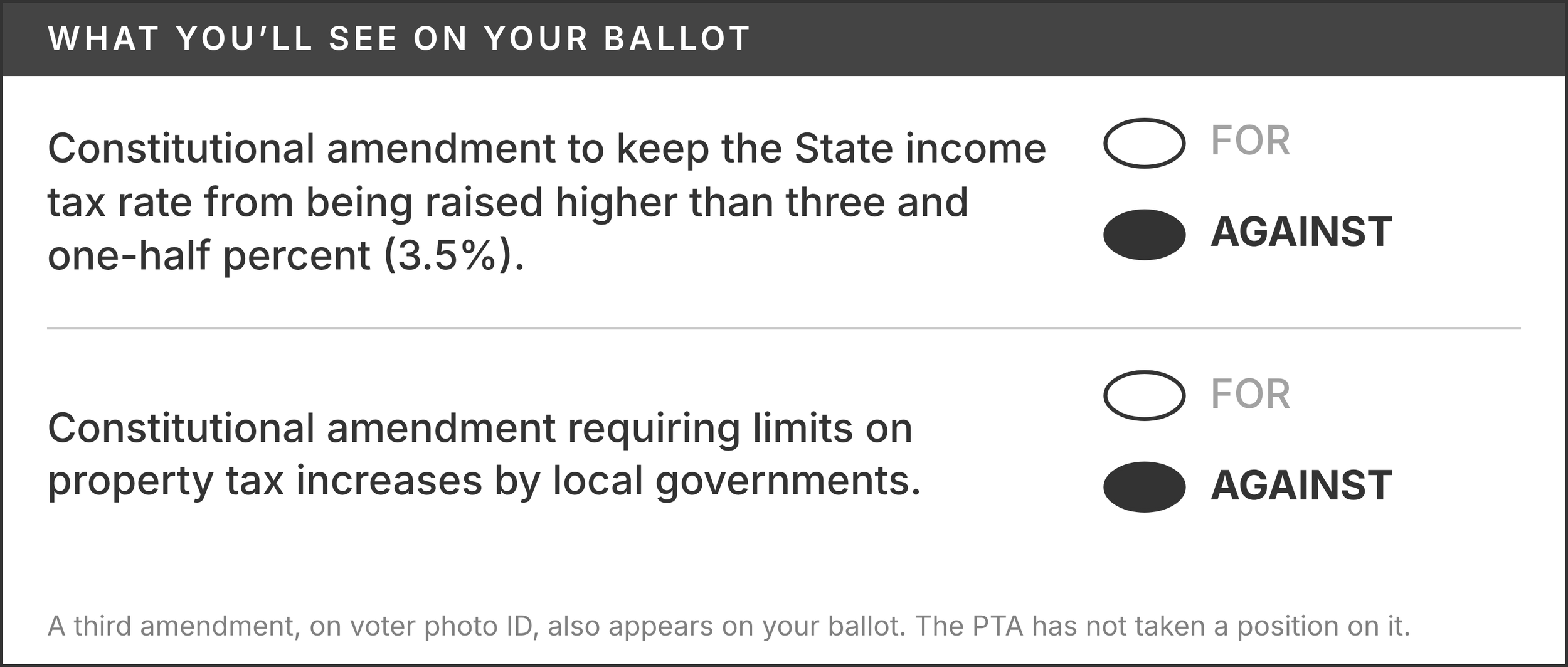
Both amendments sit near the bottom of the ballot, below the candidates, and the wording is not especially clear about what they would do. The first would lock North Carolina's constitutional income tax ceiling at 3.5 percent, permanently. The second would limit how much local property tax revenue can grow — though it doesn't say by how much, leaving that for the General Assembly to decide later.
Neither amendment changes anyone's tax bill next year. What they change is what any future legislature is able to do, and undoing a constitutional amendment takes another statewide vote.
WHY THE BOARD OPPOSES THEM
North Carolina ranks 51st out of 51 in school funding effort, which measures what a state spends on schools against what its economy could afford. That ranking comes from Making the Grade 2025, published by the Education Law Center.
Education is the single largest thing North Carolina's General Fund pays for — $19.4 billion of a $34.4 billion budget, or roughly 56 percent, in the budget enacted this past July. When state revenue is constrained, this is the line that absorbs it.
Local dollars matter here too. Roughly a quarter of North Carolina school funding comes from local sources, most of it property taxes, and that money is what pays for teacher supplements, additional staff positions, and school facilities. A cap on local revenue growth limits what Durham County is able to do for our schools, regardless of what our community decides it wants.
That is the board's concern in short: North Carolina already underfunds its public schools, and both amendments would make that harder to change.
WHEN AND HOW TO VOTE
In-person early voting ends Saturday, October 31. During early voting, you can register and vote the same day, which is not available on Election Day.
Election Day is Tuesday, November 3.
When you reach the amendments at the bottom of your ballot, each one gives you a choice of FOR or AGAINST. The board asks you to vote AGAINST the income tax cap and AGAINST the property tax levy limit.